
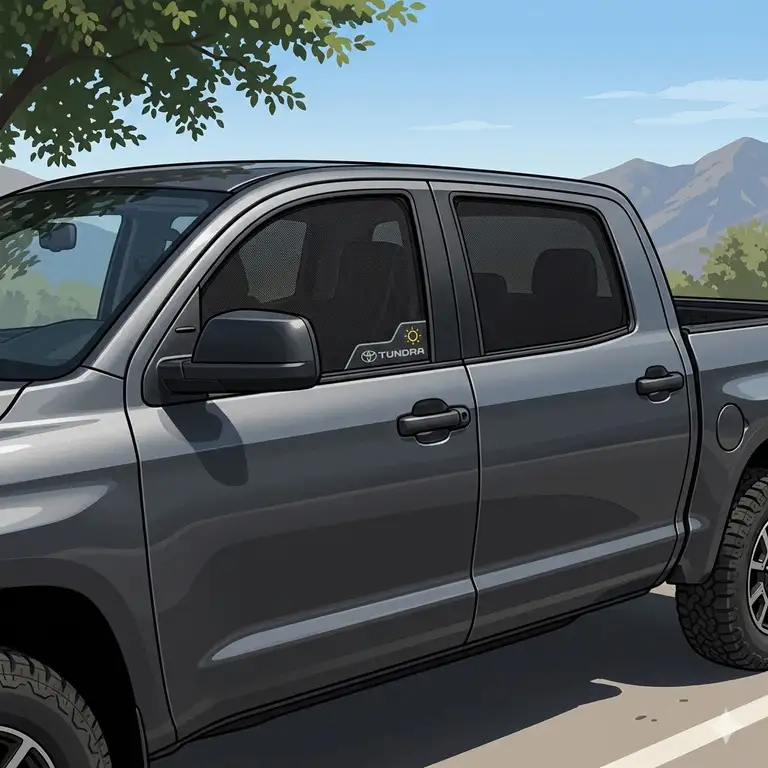
What is a window shade for a Toyota Tundra? At its core, toyota tundra window shades are custom-engineered physical barriers designed to fit the specific, massive glass dimensions of Toyota’s flagship full-size pickup. Unlike “universal” shades that leave gaps for UV rays to sneak through, these custom-fit solutions reflect solar radiation and insulate the cabin, preventing the dashboard from cracking and keeping the interior temperature manageable during scorching USA summers.
If you have ever climbed into your Tundra after it has been sitting in a Texas or Arizona parking lot for three hours, you know the “pizza oven” sensation. It is not just about personal comfort, though that is a huge factor; it is about preservation. The 2022-2026 Tundra models feature high-tech infotainment screens and premium materials that do not play well with consistent 150°F internal temperatures. Using a dedicated shade is arguably the cheapest “insurance policy” you can buy for your truck’s longevity.
In this guide, we are going deep into the world of heat management. We will look at why a $20 shade might be a waste of money while a $60 investment could save you $2,000 in leather repairs down the road. Whether you are rocking a vintage Gen 1 or a brand-new 2026 Capstone, finding the right fit is the difference between a cool ride and a scorched steering wheel.
Quick Comparison Table: Top Tundra Sun Protection Solutions
| Product Brand | Fit Type | Primary Material | Storage Style | Price Range | Best For |
| WeatherTech | Laser-Measured | Triple-Layer Foam | Roll-up | $60 – $80 | Maximum Insulation |
| Covercraft UVS100 | Custom | Triple Laminate | Accordion Fold | $90 – $110 | Premium Aesthetics |
| AutoHeatshield | Custom | ReflecTex Film | Roll-up | $50 – $70 | Daily Commuters |
| EcoNour | Semi-Custom | 240T Polyester | Twist-fold | $25 – $40 | Budget/Small Storage |
| Pigenius | Custom | Titanium Silver | Solid Fold | $45 – $60 | Modern Gen 3 Fits |
Expert Analysis of the Data:
The data above highlights a clear divide between “insulators” and “reflectors.” If you live in the Deep South, the triple-layer construction of the WeatherTech or Covercraft options justifies the higher price range because they offer a thermal barrier, not just a light block. Conversely, the EcoNour provides excellent value for those in milder climates who primarily want to keep the sun off their seats without spending a premium.
💬 Just one click — help others make better buying decisions too! 😊
[addtoany]
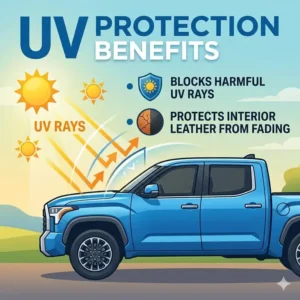
Top 5 Toyota Tundra Window Shades: Expert Analysis
1. WeatherTech Custom Fit SunShade (Full Vehicle Kits Available)
The WeatherTech system is widely considered the gold standard for Tundra owners who want a “blackout” level of fitment. These are laser-measured, which is critical for the Tundra because of the unique sensors located behind the rearview mirror in newer models.
In my experience, the dual-purpose nature of this shade is its hidden superpower. One side is reflective silver for summer, and the flip side is black to absorb heat during winter. This isn’t just a marketing gimmick; the triple-layer foam core actually keeps the cabin significantly warmer on snowy mornings. What most buyers overlook is the stiffness; because it’s a roll-up design, it won’t sag over time like cheap fabric versions. However, be prepared for it to take up a bit of room in your back seat when not in use.
-
Key Specs: CNC-cut for 2007-2026 models; dual-sided thermal protection.
-
Customer Feedback: Users frequently praise the “edge-to-edge” fit that leaves no light gaps near the A-pillars.
-
Pros:
-
Unbeatable thermal insulation
-
Made in the USA durability
-
Protects winter and summer
-
-
Cons:
-
Bulky when rolled up
-
Higher-than-average price point
-
Price Range: Around $60 for the windshield; $150-$180 for full vehicle kits.
Value Verdict: The best choice for owners who park outdoors 24/7.
2. Covercraft UVS100 Custom Sunscreen
If you care about how your truck looks while parked at the office, the Covercraft UVS100 is the “tuxedo” of toyota tundra window shades. It features a heavy-duty accordion-fold design that feels more like a structural component than a piece of foil.
The spec sheet says “triple-laminate,” but what that means for you is that the shade won’t flop over or get soft when it gets hot. I’ve seen many Tundra owners struggle with shades that “wilt” under extreme heat, but the UVS100 stays rigid. It’s specifically designed to clear the massive 14-inch screens found in the 2022+ Tundra trims without rubbing. The fit is so precise that you often don’t even need to flip your sun visors down to hold it in place.
-
Key Specs: Foam core laminate; 95% UV deflection; custom fit per generation.
-
Customer Feedback: Enthusiasts love the variety of colors (Chrome, Gold, Blue) to match their truck’s paint.
-
Pros:
-
Folds neatly and quickly
-
Very high-end aesthetic
-
Stays rigid in 110°F+ weather
-
-
Cons:
-
Can be heavy
-
Premium pricing
-
Price Range: $90 – $110 range depending on color.
Value Verdict: The top pick for those who want a blend of style and structural integrity.
3. AutoHeatshield Custom Fit Sunshade
The AutoHeatshield is a mid-range workhorse that focuses purely on heat rejection. It uses a specialized “ReflecTex” film that is highly effective at bouncing infrared waves away before they hit your dash.
The expert takeaway here is the weight-to-performance ratio. It’s significantly lighter than the WeatherTech, making it easier to whip out and install if you are in a rush. If you have a CrewMax with a lot of interior space, the roll-up storage is easy to toss into the back. It’s a no-frills product that does exactly what it says: stops your truck from becoming a microwave. It’s particularly effective for the 2nd Gen Tundra (2007-2021) which has a very deep dashboard that traps heat.
-
Key Specs: Multi-layered heat reflective material; velcro strap for storage.
-
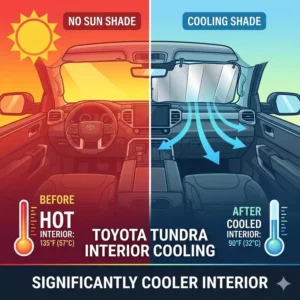
Customer Feedback: Drivers report a noticeable 30-degree drop in interior temperature compared to no shade.
-
Pros:
-
Very lightweight
-
Great price-to-performance ratio
-
Easy to clean
-
-
Cons:
-
The edges can fray after several years of use
-
Roll-up memory makes it want to curl during install
-
Price Range: $50 – $70 range.
Value Verdict: Perfect for the pragmatic owner who wants custom fit without the “premium” tax.
4. EcoNour Custom Fit Windshield Sunshade
For the budget-conscious Tundra driver, the EcoNour offers a “good enough” solution that outperforms universal shades while remaining extremely affordable. It uses a high-density 240T polyester that is much thicker than the 190T found in bargain bins.
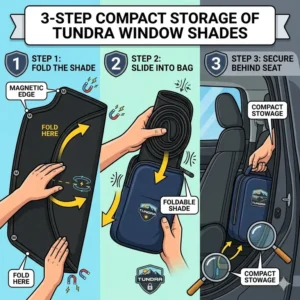
What you need to know about this model is that it uses a “two-circle” twist-fold design. While it’s marketed as “custom,” it’s more of a “tailored fit” for the Tundra’s size class. It’s the easiest to store—it shrinks down to the size of a dinner plate. If you have a cluttered interior and no room for a long roll of foam, this is your winner. Just be aware that it lacks the thermal insulation of the foam-core models; it blocks light well, but it won’t stop the ambient air from heating up as effectively as a WeatherTech.
-
Key Specs: 240T fabric; UV protection coating; storage pouch included.
-
Customer Feedback: Users appreciate how small it gets, but some note it can be tricky to fold the first few times.
-
Pros:
-
Incredibly compact
-
Very low cost
-
Simple installation
-
-
Cons:
-
Provides less thermal insulation
-
Flimsy compared to solid-core shades
-
Price Range: Around $25 – $40.
Value Verdict: The best “emergency” shade or budget option for mild climates.
5. Pigenius Custom Fit Windshield Sunshade
The Pigenius is a rising star in the Toyota community because it addresses the specific “notching” required for the latest Toyota Safety Sense (TSS) camera clusters found in 2024 and 2025 Tundras.
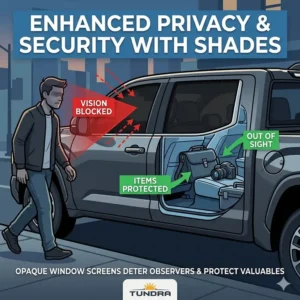
This shade uses a 10-layer “Titanium Silver” coating. Marketing speak aside, the real-world benefit is the opacity. When this is up, you cannot see a glimmer of light from the outside. This makes it a fantastic choice for Tundra owners who do “truck camping” or need privacy while taking a nap at a rest stop. It feels like a solid board once installed, giving the interior a very private, “room-like” feel.
-
Key Specs: 10-layer composite; custom-cut for TSS camera housing.
-
Customer Feedback: Many owners of the 2022+ redesign mention this fits the new mirror shape better than older brands.
-
Pros:
-
Exceptional privacy (100% opaque)
-
Tailored for the newest Tundra tech
-
High durability
-
-
Cons:
-
A bit stiff to handle in a small cab
-
Only available in silver
-
Price Range: $45 – $60 range.
Value Verdict: The best modern fit for Gen 3 Tundra tech-heavy trims.
✨ Don’t Miss These Exclusive Deals!
🔍 Take your truck protection to the next level with these carefully selected products. Click on any highlighted item to check current pricing and availability. These tools will help you create a comfortable environment your family will love!
Transformation Content: Practical Usage Guide for Your Tundra
Buying toyota tundra window shades is only half the battle; using them correctly is what actually preserves your truck. Because the Tundra has such a vertical and massive windshield, the physics of heat buildup are different than in a sedan.
Optimization Tricks for Maximum Cooling
-
The “Crack the Window” Myth: Many people think cracking the windows 1/2 inch helps. While it does vent some air, it also allows dust and pollen into your clean cab. With a high-quality WeatherTech shade, you are better off keeping the windows sealed. The shade reflects the heat back through the glass before it can turn the cabin air into a convection current.
-
The Rear Window Strategy: If you have a CrewMax with the power-sliding rear window, use it! Before you put your front shade in, roll that back window all the way down for 30 seconds to let the “heat mushroom” escape. Then, seal the truck and put the shade up.
-
Dash-Cam Compatibility: Most 2026 Tundra owners use dash cams. If your shade is too tight, it will knock your camera off the glass. Look for shades like the Pigenius or Covercraft that have a “V-notch” around the mirror. You can actually use a pair of heavy-duty shears to slightly enlarge this notch on foam shades if you need more clearance for your tech.
Maintenance for Longevity
-
Avoid “Hot Folding”: When you take the shade down, it will be physically hot. If you have a roll-up version, try to let it sit on the seat for a minute before tightly rolling it. Rolling it while the plastic is at its peak temperature can lead to “permanent curl,” where the shade refuses to sit flat against the glass next time.
-
Cleaning: Use a simple microfiber cloth with water. Never use Armor-All or silicone-based cleaners on the reflective side of your toyota tundra window shades. It will create a greasy film that can off-gas onto your windshield, creating a hazy “fog” that is a nightmare to clean off the glass.
Transformation Content: Real-World Scenario Selection
Not every Tundra owner needs the most expensive shade. Let’s look at three typical 2026 Tundra owners and find their match.
Scenario 1: The “Overlander” (Weekend Warrior)
-
Profile: You spend your weekends in the desert or mountains. You have a 2024 Tundra TRD Pro.
-
The Need: Durability and privacy for sleeping in the cab.
-
The Choice: Pigenius or WeatherTech Full Kit.
-
Reasoning: You need more than just a windshield shade. You need the side window inserts to keep the sun from baking you while you prep gear. The 10-layer opacity of the Pigenius is perfect for stealth camping.
Scenario 2: The “Daily Commuter” (City/Suburb)
-
Profile: Your truck sits in a paved office parking lot from 9 AM to 5 PM.
-
The Need: Quick setup and professional look.
-
The Choice: Covercraft UVS100.
-
Reasoning: You don’t want to be wrestling with a bulky roll-up shade while wearing a suit or work uniform. The accordion fold of the Covercraft is the fastest to deploy. It looks like a factory Toyota part, which fits the professional aesthetic.
Scenario 3: The “Value Hunter” (High-Mileage Work Truck)
-
Profile: You have a 2012 Tundra with 200,000 miles. You want to keep the dash from getting any worse but don’t want to spend $100.
-
The Need: Maximum heat rejection for minimum cost.
-
The Choice: AutoHeatshield.
-
Reasoning: It offers better fitment than a universal store-bought shade for only a few dollars more. It’s lightweight and handles the deep Gen 2 dash better than the twist-fold fabric versions.
How to Choose Toyota Tundra Window Shades: A Decision Framework
Choosing the right protection requires looking past the “shiny silver” surface. Here is the expert framework I use to evaluate these products:
-
Check Your Generation: A shade for a 2018 Tundra will not fit a 2026 Tundra. The windshield angle changed significantly in 2022. Always verify the fitment year.
-
Measure Your Tech: Do you have the oversized 14-inch screen? Do you have the Digital Rearview Mirror? These add bulk to the dash and mirror area. Look for “TSS-Compatible” descriptions.
-
Storage Real Estate: If you frequently have passengers in the back, a roll-up shade (like WeatherTech) is an annoyance because it’s 3 feet long when stowed. If you’re a solo driver, the back floorboard is a fine storage spot.
-
Material Weight: Heavier is usually better for insulation, but harder on your visors. The Tundra’s visors are sturdy, but after 10 years of holding up a 5lb shade, they can start to sag. If your truck is older, go for a lighter-weight AutoHeatshield.
-
Edge Coverage: The Tundra has massive A-pillars. If the shade is 1 inch too short on the sides, it will let in a “beam” of light that can still melt plastic over time. Custom-fit is non-negotiable for this vehicle size.
Common Mistakes When Buying Tundra Window Protection
The biggest mistake I see Tundra owners make is buying a “Jumbo” universal shade from a big-box retailer. While the Tundra is a large truck, its windshield isn’t just “big”—it’s specifically shaped. A universal shade will often be too tall, causing it to buckle in the middle, or too narrow, leaving the corners of your expensive dashboard exposed to the sun.
Another pitfall is ignoring the rear windows. According to the NHTSA, vehicle interiors can reach fatal temperatures within minutes. While the front windshield is the biggest entry point for heat, the side glass on Tundras is also quite large. If you park facing away from the sun, a front shade does nothing. This is why many Tundra enthusiasts are moving toward “Full Vehicle Kits” that include suction-cup shades for every window.
Lastly, don’t forget about the “off-gassing” factor. Cheap PVC shades can actually release chemicals when they get hot, leaving a greasy residue on the inside of your glass. Investing in a high-quality laminate like Covercraft prevents this, as they are tested for high-temperature stability.
Material Science: Reflective vs. Insulative Shades
What is the difference, and why should you care? Most cheap toyota tundra window shades are simply reflective. They use a thin layer of mylar to bounce light back. This is great for keeping the seats from getting hot to the touch, but it doesn’t do much for the air temperature inside the truck.
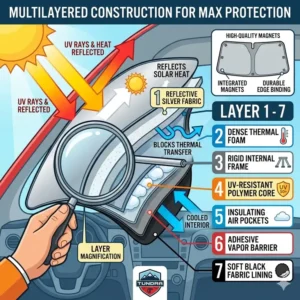
Premium options like WeatherTech or Covercraft use a “sandwich” construction.
-
Outer Layer: Reflective film (rejects the light).
-
Middle Layer: Closed-cell foam or air-bubble laminate (acts as a thermal break).
-
Inner Layer: Soft felt or plastic (protects the dash from scratches).
According to research on thermal dynamics (similar to those found in Wikipedia’s entry on Heat Shields), a thermal break is essential to stop “conductive heat.” Without that middle foam layer, the heat simply vibrates through the thin foil and warms up the air behind it. If you live in a state like Florida or Nevada, you need the insulation layer, not just the reflection.
Tundra vs. The Competition: Why Custom Fit Matters
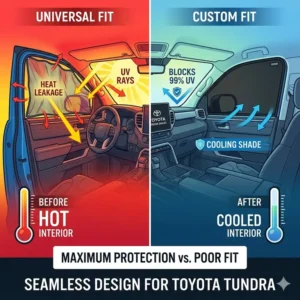
When you compare a custom AutoHeatshield to a standard “store brand” shade, the difference is roughly 15-20% more surface area coverage. In a truck as large as the Tundra, that 15% equates to about 1.5 square feet of exposed dashboard.
If you’ve upgraded to a 2024 or 2025 Tundra Limited or Platinum, you have a soft-touch dashboard that is prone to “shrinkage” if exposed to direct UV rays over several years. Leather-wrapped dashes are particularly vulnerable. A custom-fit shade ensures that even the tiny sliver of dash near the VIN plate is covered.
Furthermore, custom shades are designed to work with the Tundra’s specific visor tension. Since the Tundra visors are quite far apart, a flimsy universal shade will often fall down in the middle. Custom shades have the structural integrity to span that distance without “waisting” or bowing.
Features That Actually Matter (And Those That Don’t)
Marketing for toyota tundra window shades is full of buzzwords like “NASA-inspired” or “Titanium infused.” Let’s cut through the noise.
What Actually Matters:
-
Binding Quality: Look for shades with a fabric-stitched edge. Raw-cut foil edges will eventually peel and flake, leaving silver “glitter” all over your carpet.
-
Stiffness: A shade that can’t hold its own weight is a nuisance.
-
UV Rating: Ensure it blocks 95% or more of UV rays. This is what stops the yellowing of your plastic trim.
What Doesn’t Matter:
-
Suction Cups (for the windshield): If a windshield shade needs suction cups, it’s probably not a good fit. A proper custom shade should be held up by the visors alone. Suction cups leave rings on the glass and eventually fail in the heat.
-
Storage Bags: While nice, most people end up throwing the bag under the seat and never using it again. Don’t pay extra for a “premium” carry case.
-
Patterned Designs: While a “flag” or “camo” print looks cool, the ink can actually absorb more heat than a plain silver surface. Stick to silver or white for the best thermal performance.
Long-Term ROI: Why This Accessory Pays for Itself
If you plan to sell your Tundra in 5 to 10 years, the condition of the interior will be a major factor in its resale value. According to automotive valuation trends on Consumer Reports, a truck with a cracked dash or faded upholstery can lose $1,000 to $2,500 in trade-in value compared to a “mint” interior.
A $60 investment in toyota tundra window shades is essentially an insurance policy for that value. Beyond the resale, think of the fuel savings. If your truck starts at 100°F instead of 140°F, your air conditioning doesn’t have to work as hard. This puts less strain on the alternator and the engine, potentially saving you a few cents in fuel every single day. Over 10 years, that adds up!
✨ Don’t Miss These Exclusive Deals!
🔍 Take your truck to the next level with these carefully selected products. Click on any highlighted item to check current pricing and availability. These tools will help you create a comfortable environment your family will love!
Conclusion
Protecting your investment is a hallmark of a responsible truck owner. The Toyota Tundra is a legendary machine known for lasting 300,000 miles or more—but the interior will only last that long if you protect it from the relentless USA sun. By choosing high-quality toyota tundra window shades, you aren’t just buying a piece of foil; you are buying comfort, privacy, and long-term value.
From the premium, structural feel of the Covercraft UVS100 to the versatile, dual-season utility of the WeatherTech, there is a solution for every budget. Don’t wait until you see the first hairline crack in your dashboard to take action. Grab a custom-fit shade today and enjoy a truck that stays as cool as it looks.
FAQs
❓ Do I need a different shade for the Tundra CrewMax vs. Double Cab?
✅ For the front windshield, no. The windshield glass is identical across all cab configurations within the same generation. However, if you are buying side window shades, the CrewMax has significantly larger rear door glass than the Double Cab…
❓ Can I use a Toyota Tundra shade in a Toyota Sequoia?
✅ Generally, yes. The 2nd Gen Sequoia (2008-2022) shares the same front end as the 2nd Gen Tundra. Similarly, the 2023-2026 Sequoia is built on the same platform as the Gen 3 Tundra, so the shades are usually interchangeable…
❓ Will a window shade interfere with my Toyota Safety Sense (TSS) camera?
✅ If you buy a custom-fit brand like WeatherTech or Pigenius, they are designed with a cutout for the TSS sensor housing. Universal shades often block or press against the sensor, which can potentially knock it out of alignment…
❓ Is a folding shade better than a roll-up shade?
✅ It depends on your storage preference. Folding (accordion) shades like the Covercraft are easier to stow and tend to look more “professional.” Roll-up shades like AutoHeatshield offer fewer seams, which some believe provides slightly better heat rejection…
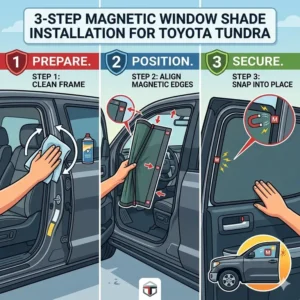
❓ Are “magnetic” window shades safe for the Tundra?
✅ Magnetic shades are usually for the side windows, not the windshield. They are safe and effective, but ensure your Tundra’s window frame is actually steel. Many modern trucks use aluminum or plastic trim that magnets won’t stick to…
Recommended for You
- Tundra Windshield Shade: 7 Best Sun Shades for Your Truck (2026)
- 7 Best Tundra Sun Shade Picks for Your Toyota Truck in 2026!
- Toyota Tundra Sun Shade: 7 Best Rated Protectors for 2026 (Expert Picks)
Disclaimer: This article contains affiliate links. As an Amazon Associate, I earn from qualifying purchases. If you purchase products through these links, we may earn a small commission at no additional cost to you.
✨ Found this helpful? Share it with your friends! 💬🤗
[addtoany]
