
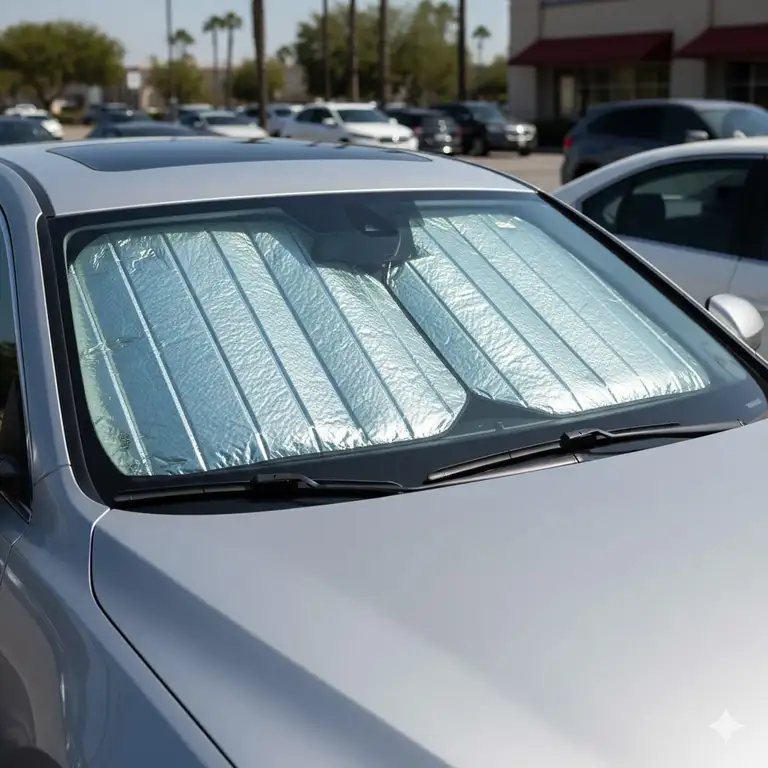
You know the feeling, don’t you? ☀️
It’s that 3 PM living room glare that turns your couch into a “do not sit” zone. Or, even worse, opening your car door after work and getting hit by a wave of heat so intense it feels like you’re on the surface of the sun. Your steering wheel is a fire hazard, and the A/C will have to work overtime just to make the space bearable.
We accept this as normal, but honestly, it’s not. There’s a simple, powerful solution: the window heat shield.
✨Was this helpful? Spread the word! 🚀
[addtoany]
Whether you’re trying to protect your car’s dashboard from cracking or slash your home’s summer energy bills, a good window heat shield is a game-changer. But “window heat shield” is a broad term. It can mean a foldable shade for your car, a high-tech film for your home, or a rugged cover for your RV.
So, how do you choose? You’re in luck. I’ve spent the time sorting through the options, from automotive to residential, to find out what actually works.
Before we dive deep, let’s see how a dedicated window heat shield stacks up against the old-school methods.
Comparison: Window Heat Shield vs. Traditional Solutions
| Feature | Window Heat Shield (Film/Auto) | Heavy Blackout Curtains | Standard Blinds (Vinyl/Wood) |
| Heat Rejection | 🥇 Excellent (Reflects heat) | Fair (Absorbs heat, then radiates) | Poor to Fair (Absorbs/leaks heat) |
| UV Protection | 🥇 Excellent (Often 99%+) | Good (Blocks light, not all UV) | Poor |
| Energy Savings | 🥇 Excellent | Good | Fair |
| View Obstruction | Varies (Film = No, Shade = Total) | Total | Partial to Total |
| Installation | Easy (Auto) to Moderate (Film) | Easy | Moderate |
As you can see, for pure heat fighting, nothing beats a product designed to reflect sunlight before it becomes heat. Now, let’s get to the top picks.
📈 Quick Comparison: Top Window Heat Shield Picks for 2025
Here’s a quick glance at the 7 best solutions I found, covering every possible need.
| Product | Type | Best For | Key Feature |
| EcoNour Car Windshield Sun Shade | Automotive (Foldable) | Daily Drivers (Budget) | Amazing portability & storage |
| Covercraft UVS100 Sunscreen | Automotive (Rigid) | Premium Protection (Custom) | Perfect custom-fit, foam core |
| Motor Trend Front Windshield Sun Shade | Automotive (Foldable) | Best Value | 2-piece design for overlap fit |
| GILA Titanium Heat Control Film | Residential (DIY Film) | Home Energy Savings | High heat rejection, low VLT |
| Velimax Static Cling Blackout Film | Residential (DIY Film) | Total Privacy & Light Block | 100% light-blocking, static cling |
| Camco RV SunShield | Specialty (RV Cover) | RVs and Campers | Thick insulation, easy fasteners |
| Coolaroo Exterior Roller Shade | Residential (Exterior Shade) | Patios & Large Windows | Blocks heat before the glass |
💎 Top 7 Window Heat Shield Solutions: Expert Analysis
I’ve sifted through hundreds of reviews, product specs, and forum discussions. Here are the 7 products that consistently rise to the top for performance, quality, and value.
1. EcoNour Car Windshield Sun Shade (Best Budget Auto)
If you’ve ever searched for a car sunshade, you’ve seen this one. It’s an absolute best-seller, and for good reason. It’s not a fancy rigid board; it’s a flexible, foldable “pop-up” style shield.
-
Specifications:
-
Type: Foldable (2-piece “twist-to-fold” circles)
-
Material: 240T reflective polyester
-
Sizes: Comes in multiple universal sizes (Standard, Large, XL) to fit different vehicles.
-
-
Customer Review Analysis:
-
People love how small this thing gets. It folds into a tiny pouch you can easily stick in a door pocket or seat-back pocket.
-
The overwhelming consensus is that it works. Users in Arizona and Florida report a “night and day” difference in interior car temps.
-
The main critique is durability. After a year or two of daily use, the wireframe can get bent, or the material might flake. But at its price point, most see this as a fair trade-off.
-
-
Pros:
-
✅ Extremely compact and easy to store.
-
✅ Very affordable.
-
✅ Surprisingly effective at heat reduction.
-
-
Cons:
-
❌ Fit is “universal,” so it’s not a perfect 100% custom fit.
-
❌ Not as durable as rigid models.
-
2. Covercraft UVS100 Custom Sunscreen (Best Premium Auto)
If the EcoNour is the budget champion, the Covercraft UVS100 is the heavyweight professional. This is for the person who wants a perfect fit, maximum protection, and is willing to pay for it.
-
Specifications:
-
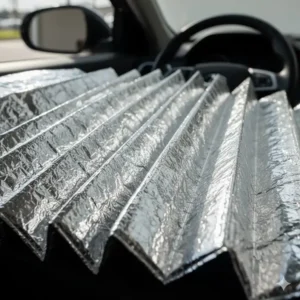
Type: Rigid (Accordion-fold)
-
Material: Thick foam core with a reflective triple-laminate outer layer.
-
Sizes: Custom-made for your vehicle’s specific year, make, and model.
-
-
Customer Review Analysis:
-
The #1 praise is the fit. Reviewers say it fits “like a glove,” with perfect cutouts for mirrors and sensors.
-
Its insulating power is legendary. The foam core doesn’t just reflect heat; it insulates against it. This means the shield itself doesn’t get as hot.
-
The only complaints are price (it’s an investment) and storage. It’s bulky. You’re not tucking this in a door pocket; it lives on the passenger seat or in the trunk.
-
-
Pros:
-
✅ Flawless, custom fit.
-
✅ Exceptional insulation and heat blocking.
-
✅ Extremely durable and long-lasting.
-
-
Cons:
-
❌ Expensive.
-
❌ Very bulky to store.
-
3. Motor Trend Front Windshield Sun Shade (Best Value Auto)
The Motor Trend shade hits the sweet spot between the ultra-budget EcoNour and the premium Covercraft. It’s a 2-piece design that’s meant to overlap, giving you more coverage flexibility.
-
Specifications:
-
Type: Foldable (2-piece, pop-up)
-
Material: Reflective nylon material
-
Sizes: Comes in 3 sizes (Standard, Large, X-Large)
-
-
Customer Review Analysis:
-
Users like the 2-piece design because it allows them to adjust the overlap for a better fit around the rearview mirror.
-
It’s noted as being lightweight and easy to fold (once you get the “twist” motion down).
-
Similar to other pop-up shades, longevity is a concern for some, but its performance for the price is consistently rated high.
-
-
Pros:
-
✅ Great price for the quality.
-
✅ 2-piece design offers a flexible fit.
-
✅ Lightweight and stores small.
-
-
Cons:
-
❌ The “overlap” solution isn’t as clean as a 1-piece.
-
4. GILA Titanium Heat Control Window Film (Best DIY Home Film)
Moving to the home, GILA is a name you need to know. This isn’t a shade; it’s a high-tech window film you apply directly to the glass.
-
Specifications:
-
Type: Residential Film (Adhesive)
-
Material: Metallized (Titanium)
-
Specs: Rejects up to 71% of TSER (Total Solar Energy Rejected), blocks 99% of UV rays.
-
-
Customer Review Analysis:
-
The results are dramatic. People with south-facing windows say this film instantly cooled their rooms by 10-15°F.
-
It has a noticeable “mirror” tint on the outside, which adds daytime privacy (a huge bonus).
-
Warning: The installation is a pain. This is the #1 complaint. You need a spotless window, tons of application solution, and a good squeegee. Rushing it will result in bubbles.
-
-
Pros:
-
✅ Incredible heat and UV rejection.
-
✅ Adds daytime privacy (exterior reflective finish).
-
✅ “Set it and forget it” solution.
-
-
Cons:
-
❌ Installation is challenging and time-consuming.
-
❌ Creates a permanent, noticeable tint.
-
❌ Critical: Not recommended for dual-pane windows (can cause seal failure). Check your windows first!
-
5. Velimax Static Cling Blackout Window Film (Best for Total Blockage)
What if you don’t just want less heat, you want zero light? Think: a nursery, a home theater, or a shift worker’s bedroom. Velimax‘s static cling film is the answer.
-
Specifications:
-
Type: Residential Film (Static Cling)
-
Material: Vinyl
-
Specs: 100% light-blocking, 99% UV rejection.
-
-
Customer Review Analysis:
-
It delivers on its promise: total darkness. Users are amazed that it turns day into night.
-
Because it’s static cling, installation is much more forgiving than adhesive film. You can pull it off and re-stick it.
-
The “black” side faces out, so it absorbs heat at the pane. It’s more of a “light shield” than a “heat shield,” but by blocking 100% of light, it also blocks the heat that light carries.
-
-
Pros:
-
✅ 100% blackout.
-
✅ Static cling = easy, non-permanent installation.
-
✅ Excellent for privacy.
-
-
Cons:
-
❌ Not “reflective,” so it absorbs heat at the glass.
-
❌ Not aesthetically pleasing from the outside (just black).
-
6. Camco RV SunShield Reflective Window Cover (Best for RVs)
RVs are basically greenhouses on wheels. The large, flat windshields are notorious for letting in staggering amounts of heat. The Camco RV SunShield is built specifically for this.
-
Specifications:
-
Type: Specialty (RV Interior Panel)
-
Material: Reflective layer with a thick bubble-pack insulation core.
-
Sizes: Specific sizes for RV windshields, side windows, and vents.
-
-
Customer Review Analysis:
-
RV owners swear by this. The thick insulating core makes a huge difference, not just for heat in the summer but also for retaining heat in the winter.
-
It attaches with hook-and-loop (Velcro-style) fasteners, making it easy to put up and take down.
-
It provides 100% privacy, which is a massive plus in a crowded campground.
-
-
Pros:
-
✅ Excellent insulator (hot and cold).
-
✅ Easy to install and remove.
-
✅ Durable and cut for RV-specific windows.
-
-
Cons:
-
❌ Bulky to store (it’s a thick panel).
-
❌ The hook-and-loop fasteners are permanent on the window frame.
-
7. Coolaroo Exterior Roller Shade (Best Exterior Home Solution)
This is my “think outside the box” pick. Why block heat after it’s already hit your window? The Coolaroo Exterior Shade blocks it before it ever touches the glass.
-
Specifications:
-
Type: Residential (Exterior Shade)
-
Material: Woven “HDPE” fabric (not solid)
-
Specs: Blocks up to 90% of UV rays while allowing airflow.
-
-
Customer Review Analysis:
-
This is the ultimate solution for patios, decks, and large windows. Users are shocked at how much it cools their outdoor spaces and the adjacent indoor rooms.
-
The “knitted” fabric is a key feature. It blocks heat and sun, but you can still see through it (vaguely), and it lets a breeze pass through.
-
Installation is more involved (it’s a permanent fixture), but the hand-crank operation is smooth and reliable.
-
-
Pros:
-
✅ The most effective way to block heat (externally).
-
✅ Preserves your view (partially) and allows airflow.
-
✅ Adds a usable, shaded space to your home’s exterior.
-
-
Cons:
-
❌ Requires permanent installation (drilling).
-
❌ More expensive than interior solutions.
-
✨ Don’t Miss These Exclusive Deals! 🔍
<p>Ready to finally cool down your car, home, or RV? These products are proven to work. Click on any of the highlighted items above to check the latest availability and explore options. Your A/C (and your wallet) will thank you!
💬 Just one click – help others make better buying decisions too!😊
[addtoany]
☀️ What Exactly is a Window Heat Shield and How Does It Work?
A window heat shield is any product designed to stop solar energy (both light and heat) from passing through a window. Simple, right? But the science is pretty cool.
Sunlight is made of a few things, but for us, what matters is:
-
Visible Light: What we see (and what causes glare).
-
Ultraviolet (UV) Rays: The invisible rays that cause fading, cracking, and sunburn.
-
Infrared (IR) Rays: The invisible rays that we feel as heat.
A plain glass window is a perfect doorway for all three. A window heat shield works in one of three ways:
-
Reflection (Best): A reflective surface (like a car shade or mirrored film) bounces these rays back out before they can enter. This is the most effective method.
-
Absorption (Good): A dark or tinted material (like some window films or curtains) absorbs the energy. This is better than nothing, but the material itself gets hot and then radiates that heat into the room.
-
Insulation (Different): A thick core (like in the Covercraft or Camco) creates an air barrier that slows down the transfer of heat.
A high-quality heat shield for window use will have a high IR Rejection and UV Rejection rate.
🚗 The 3 Main Types of Window Heat Shields
We’ve covered some in the products, but let’s break down the main categories you’ll encounter.
1. Automotive Shields (The Classic “Sunshade”)
This is what most people think of. They are designed for your car’s windshield and are all about ease of use.
| Feature | Foldable (Pop-Up) | Rigid (Accordion) |
| Storage | 🥇 Excellent (Folds tiny) | Poor (Very bulky) |
| Fit | Good (Universal) | 🥇 Excellent (Custom-fit) |
| Durability | Fair | 🥇 Excellent |
| Insulation | Poor (Reflects only) | 🥇 Excellent (Reflects + Insulates) |
2. Residential Window Films
This is a more permanent heat shield for windows in home settings. It’s a thin layer applied directly to the glass.
| Feature | Adhesive Film | Static Cling Film |
| Longevity | 🥇 Excellent (5-15 years) | Good (1-3 years, or seasonal) |
| Installation | Difficult (Requires precision) | 🥇 Easy (Forgiving, repositionable) |
| Removal | Very Difficult (Leaves residue) | 🥇 Easy (Peels off, no residue) |
| Best For | Long-term, “set-and-forget” | Renters, seasonal use, DIY beginners |
Diving deeper into films, the material matters more than the adhesion.
| Film Type | How it Works | VLT (Visible Light) | Cost |
| Reflective / Metallized | Bounces sun with a mirror-like layer. | Low (Dark/Mirrored) | $$ |
| Tinted / Dyed | Absorbs heat (less effective). | Low (Dark) | $ |
| Ceramic | Uses nano-ceramic particles to block IR (heat) without blocking light. | 🥇 High (Clear) | $$$$ |
3. Exterior & Specialty Shields
This category includes everything else, from the Camco RV covers to exterior shades like the Coolaroo. Their main advantage is stopping heat before the glass, which is scientifically the most effective method. According to the U.S. Department of Energy, exterior shades and films are highly effective at reducing solar heat gain.
💰 The Undeniable Benefits of Using a Window Heat Shield
Is a window heat shielding solution really worth the hassle or cost? Absolutely.
-
✅ Massive Energy Savings: This is the big one for homes. By rejecting up to 80% of solar heat, your A/C doesn’t have to fight a losing battle. This can lead to 15-30% savings on your cooling bills.
-
✅ Protects Your Interior: UV rays are poison for your car’s dashboard and your home’s furniture. A window heat shield blocks 99%+ of this UV, preventing fading, cracking, and sun damage.
-
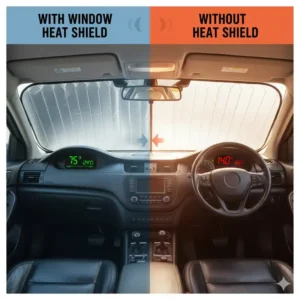
✅ Enhanced Comfort: This is the “feel” benefit. Your car isn’t an oven. That one room in your house is finally usable. No more blinding glare on the TV.
-
✅ Privacy: Many shields (especially mirrored film and blackout shades) add significant daytime privacy.
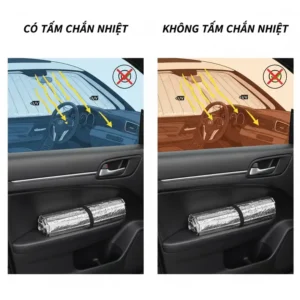
Benefits at a Glance: Shield vs. No Shield
| Metric | Standard Window (No Shield) | With Quality Heat Shield |
| Est. Interior Temp (Car) | 130°F – 160°F | 90°F – 110°F |
| Est. A/C Savings (Home) | 0% | 15% – 30% |
| UV Blockage | ~25% (Basic Glass) | 99% |
| Glare Reduction | 0% | 50% – 90% |
📋 How to Choose the Right Heat Shield for Your Window
Feeling overwhelmed? Don’t be. Just follow this simple process.
Step 1: Identify Your “Why”
-
For your car? You need an automotive shield. Decide between budget/storage (foldable) or max protection/fit (rigid).
-
For your home? Do you own or rent? Want a clear view or total blackout? This points you to either film, interior, or exterior shades.
-
For your RV? Get a specialty insulated cover like the Camco.
Step 2: Measure, Measure, Measure!
For home films and exterior shades, this is obvious. For car shades, do not guess. A “universal” fit often isn’t. Measure your windshield’s height and width and compare it to the product’s size chart. A shade that’s too small is useless.
Step 3: Understand the Lingo (For Home Films)
-
VLT (Visible Light Transmittance): How much light gets through. A low VLT (e.g., 20%) is dark. A high VLT (e.g., 70%) is almost clear.
-
IR Rejection: How much heat is blocked. This is the most important number! Look for 80% or higher.
-
TSER (Total Solar Energy Rejected): The all-in-one number. This accounts for UV, visible light, and IR. A TSER of 50%+ is good. 70%+ is excellent.
Step 4: Installation (DIY vs. Pro)
Be honest with yourself. Are you a patient, meticulous person?
-
Car Shades: 10 seconds. Anyone can do it.
-
Static Cling Film: Pretty easy. A 3/10 on the difficulty scale.
-
Adhesive Film: Difficult. An 8/10. Requires a clean room, patience, and a squeegee. Watch multiple tutorials.
-
Exterior Shades: A 7/10. Requires a drill, a level, and a helper.
DIY vs. Professional Installation Comparison
| Factor | DIY (e.g., GILA Film) | Professional Install (e.g., 3M) |
| Cost | 🥇 $ | $$$$ |
| Time | 2-4 hours per window | 30-60 mins per window |
| Risk | High (Bubbles, dust, creases) | 🥇 Low (Guaranteed result) |
| Warranty | Product only | 🥇 Product + Labor (Lifetime) |
🔧 A Step-by-Step Guide to Installing Your Window Heat Shield (DIY)
Okay, so you’ve bought your shield. Here’s the “quick start” guide.
How to Install an Automotive Sunshade
I’m hoping we don’t need a guide for this, but just in case:
-
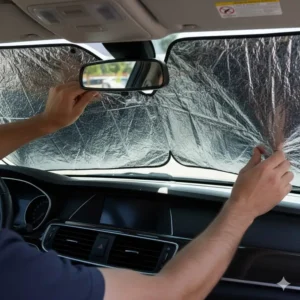
Unfold it. (The “twist” for pop-up shades is the hardest part. Twist and let it spring open… carefully.)
-
Place it. Tuck the bottom edge against the dashboard.
-
Secure it. Flip down your sun visors. This holds the shield tight against the glass.
-
That’s it. You’re done.
How to Install a Home Window Film (Static Cling)
This is the one people get wrong. Don’t be one of them.
-
Clean the window. I mean spotless. Scrape it with a razor. Use glass cleaner. Any speck of dust will become a bubble.
-
Measure and Cut. Measure the glass (not the frame) and cut your film 1 inch larger on all sides. You will trim it later.
-
SPRAY EVERYTHING. Get a spray bottle and fill it with water + a tiny drop of baby shampoo. Spray the window until it’s dripping. Spray your hands. Spray the film (both sides) as you peel the backing off. You cannot use too much water.
-
Apply the Film. The “wet” side of the film goes on the “wet” window. Because it’s all wet, you can slide it around into the perfect position.
-
Squeegee. Starting from the center, use a squeegee to push the water and air bubbles out to the edges.
-
Trim. Take a sharp utility knife and a credit card (as a guide). Press the card into the window frame gasket and trim the 1-inch excess film for a perfect, clean edge.
-
Final Squeegee. Do one last pass to get the last bits of water out. It may look hazy for a day or two—that’s normal.
📈 The Long-Term ROI: Is a Window Heat Shield Worth It?
Let’s talk money. A $30 car shade seems straightforward, but what about a $150 exterior shade or $200 in window film?
-
For your car: A Covercraft UVS100 costs ~$90. A new, cracked dashboard? $1,500+. The payback period is… immediate.
-
For your home: Let’s say your summer cooling bill is $300/month. A 20% reduction (a conservative estimate for window film) is $60/month. If you spend $180 on DIY film for your hottest windows, your payback period is 3 months. After that, it’s pure profit, year after year.
This isn’t just about comfort; it’s a smart financial decision. A heat shield for window use is an investment that pays for itself.
Cost vs. Lifespan
| Tier | Example | Initial Cost | Est. Lifespan | Value Prop |
| Budget | EcoNour Shade | $15 – $25 | 1-2 years | Low cost, high convenience |
| Mid-Range | GILA DIY Film | $30 – $60 (per window) | 3-5 years | Best bang-for-your-buck |
| Premium | Covercraft / Exterior Shade | $90 – $200+ | 5-10+ years | Maximum performance & durability |
❌ Common Mistakes to Avoid
-
Buying the Wrong Size. I said it before, I’ll say it again. Measure.
-
Bad Film Installation. Rushing the job, not using enough water, or working on a dirty window will lead to a bubbly, peeling mess.
-
Ignoring Your Windows (Home). You must not use highly reflective film on dual-pane (or “double-glazed”) windows unless the manufacturer specifically says it’s okay. The heat buildup between the panes can break the seal.
-
Forgetting Local Rules. Your HOA or apartment complex may have rules against “mirrored” or “shiny” windows. Check first.
🚀 Take the Next Step to a Cooler Life! 🚀
You’re now an expert on window heat shields. The only thing left to do is pick the one that’s right for you. Browse the top-rated products we reviewed, check the specs, and make this the last summer you spend sweating in your own space. Click any of our product links to get started!
🏁 Conclusion: Your Comfort is One Shield Away
From the blistering heat of a parked car to the relentless afternoon sun in your living room, excess solar heat is more than an annoyance—it’s a costly, uncomfortable, and damaging problem.
A window heat shield is the single most effective tool in your arsenal to fight back.
We’ve covered everything from budget-friendly pop-up shades like the EcoNour to high-tech home films like GILA and premium custom-fit monsters like the Covercraft UVS100.
The choice comes down to your specific need, but the solution is clear. Stop dealing with the heat and start defeating it.
❓ Frequently Asked Questions
❓ What's the best window heat shield for a car?
❓ How much does a home window heat shield film cost?
❓ Where can I buy a custom window heat shield?
❓ What's the best window heat shield for an RV?
❓ Is window heat shield film better than blackout curtains?
📚 Recommended for You
- Cardboard Windshield Sun Shade: 7 Surprising Picks to Beat the Heat and Protect Your Car [2025]
- 7 Best Truck Side Window Shades 2025: UV Protection Guide
- Windshield Reflector Heat Shield: Top 7 Expert Picks 2025
Disclaimer: This article contains affiliate links. If you purchase products through these links, we may earn a small commission at no additional cost to you.
✨ Found this helpful? Share it with your friends! 💬🤗
[addtoany]
